You didn’t fail on the maths.
You failed on the signal.
Three hundred LeetCode problems behind you, every problem set you could find worked through, and a rejection email one sentence long. The gap is not what you know. It is what the person across the table was writing down while you talked.
Instant download · One payment · 30-day money-back guarantee
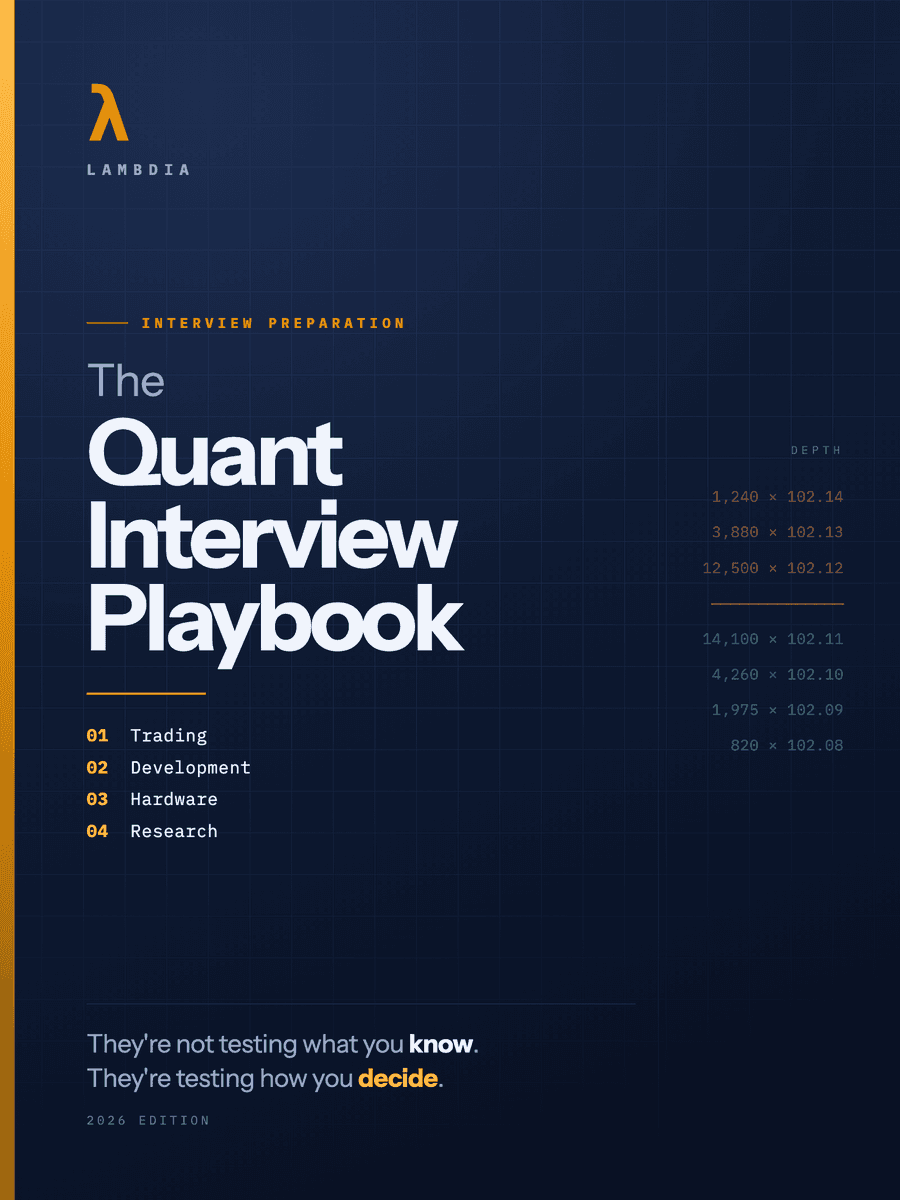
You did the work. You still got the rejection email.
None of that is a knowledge gap. It’s a signalling gap.
Fifteen years on the other side of the table.
I have spent fifteen years recruiting for quant roles. Screening, running rounds, and sitting in the debriefs where the decision actually gets made — the conversation you never hear, about you, after you leave the room.
Several hundred candidates have come through that process with me and gone on to the seat they were aiming at. The strongest of them opened on packages above $500,000.
Built for the interview formats used at:





















Pick your track. Skip everyone else’s.
Trading
Market making, edge and expected value, and mental math at the speed the clock actually demands. At Optiver and SIG the first filter is arithmetic, not theory, and strong maths graduates fail it on speed alone.
Development
Low-latency C++ and Python, systems, order books. Plus the design rounds that separate an engineer who can build from an engineer who gets hired.
Hardware (FPGA)
Verilog, timing closure, pipelining, clock-domain crossing. And the trading-floor context that generic FPGA prep leaves out, because the question is never only whether the design meets timing.
Research
Statistics, signals and machine learning, and the question sitting under all of it: would this survive out of sample? Everyone in the room knows the model. The job is being trusted with the call.
What’s in the 412 pages
How the pipeline actually works
Screen to superday, firm by firm: who runs each round, how long it lasts, what it filters for, and what’s genuinely negotiable when the offer arrives.
Resume, referrals and the behavioural layer
What a referral changes and what it doesn’t, why the same CV reads differently at a prop shop and at a fund, and how to answer the why-quant question without sounding like everyone else.
Mental math at the speed of the filter
The arithmetic that survives a clock, drilled to the standard Optiver and SIG actually apply on the trader track.
Probability and EV as moves, not formulas
Conditioning, symmetry, indicators. The handful of moves that generate an answer when you’ve never seen the question before, which is the situation the round is designed to create.
Brainteaser archetypes and Fermi estimation
Most puzzles are one of a small number of shapes. Recognise the shape in the first thirty seconds and the rest is bookkeeping.
Your track, in depth
One full part each for trading, development, FPGA and research. You read yours and skim the rest, which is why the book is routed instead of averaged.
Four annotated mock interviews
Complete transcripts with the interviewer’s scoring rubric running down the margin. You see what was being written down while the candidate talked.
281 exercises, every one original
Written for this book, not recycled from problem sets you have already seen. Each solution names the move that cracks it instead of asserting the answer.
The 8-week and 12-week plans
Day by day. Pick the one that fits the time you actually have before your first round, not the time you wish you had.
Where the 411 pages actually go.
Measured from the built file, not rounded up.
| Part | What it covers | Ch. | Pages |
|---|---|---|---|
| Front matter | What this is, why candidates fail, how to work through it | 3 | 8 |
| I · The Game | Who hires, the pipeline firm by firm, how rounds are scored, the soft round | 5 | 34 |
| II · Universal Core | Mental math, counting, probability, estimation, statistics, brainteasers | 6 | 65 |
| III · Trading | Market making, sizing, option logic, Greeks, markets, stochastic calculus | 6 | 54 |
| IV · Development | Patterns, Python, C++, concurrency, ML, low latency, numerics | 7 | 67 |
| V · Hardware | Synthesisable RTL, HDL, fabric, timing, CDC, verification, tick-to-trade | 7 | 43 |
| VI · Research | Research rounds, linear algebra, inference, time series, ML, your project, an alpha case study | 7 | 51 |
| VII · Drills | Mocks, firm pages, formula sheets, the plans, the exercise bank, self-check | 7 | 87 |
| 48 | 412 | ||
Inside the 86 pages of drills
- Exercise bank20 pages
- Four annotated mock interviews15 pages
- 24 firm one-pagers13 pages
- Printable formula sheets12 pages
- The 8-week and 12-week plans11 pages
- Self-check and glossary14 pages
One track runs about 55 pages on top of the 66-page universal core, so the reading you actually owe is nearer 120 pages than 411. The rest is reference you keep open while you drill, and three tracks that are not yours.
Built around what the round scores. Not around a problem bank.
Lambdia’s method is visual: you keep what you’ve seen, not what you’ve highlighted. This book is built the same way. Diagrams carry the reasoning and transcripts carry the pressure. Nothing in it is an answer key.
It also corrects what circulates. A handful of answers get repeated so widely in interview prep that candidates arrive having memorised them, and several are wrong: a conditional expectation off by a factor of two, a positive-semidefinite test stated the wrong way round. Memorise one of those and you have memorised a mistake, and the person who wrote your question knows it.
It also routes you. Trading, development, FPGA and research are four different jobs with four different filters, and one curriculum averaged across all four fits none of them.
What the book changed.
I had about 300 LeetCode problems under my belt and still blanked the first time someone said ‘make a market.’ Wrong kind of practice. The chapter on quoting a width before a level is what finally clicked — I started saying a number out loud instead of hunting for the ‘correct’ formula. That alone changed how the rest of the round went.Nobody told me the online assessment was basically a speed filter. I knew the answers and still timed out. I ran the eight-week plan almost day by day, mostly the mental math drills, and retook something similar at another firm two months later. Same material. Completely different result. I wish I’d bought this before the first try, not after.I kept getting the right final answer and still walking out with a one-line rejection. The annotated mocks fixed that for me. Seeing the scoring notes in the margin while the candidate talks is weirdly uncomfortable the first time — then useful. I stopped performing correctness and started showing how I decide under uncertainty. That’s the part I never got from the Green Book.Written for you if…
Final year or master’s
You’re applying in the 2027 cycle and this window is the one you get.
PhD converting
Physics, maths or CS. Real mathematical maturity, no finance, no idea what a superday is.
Working engineer
Dev or FPGA, moving to a trading firm. You can build. You’ve never been scored on how you think out loud.
Second attempt
You reached the on-site last cycle and didn’t convert, and the feedback was one sentence long.
Everything you get
- ✓The full book — 412 pages, PDF, readable on every device and built to print.
- ✓Four annotated mock interviews — full transcripts with the interviewer’s scoring rubric in the margin.
- ✓281 original exercises — written for this book, each with a worked solution.
- ✓24 firm one-pagers and printable formula sheets — the reference you keep open while you drill.
- ✓The 8-week and 12-week plans — day by day, whichever one fits your calendar.
- ✓Lifetime updates — firms change their process, and you get every revision.
J
30-day money-back guarantee. Read it, run a week of the plan. If it doesn’t change how you answer, one email gets you a full refund and you keep the PDF.
Expires in --:--:--
This price is held for 90 minutes from your first visit. One payment, no renewal, no expiry. Thirty days to change your mind, and the PDF stays yours either way.
Before you buy
Why not just grind free problem sets?
Grind them as well, they are useful. But a problem set is a problem set: answers to memorise, with nothing on how a round is actually scored, nothing on mental math under a clock, nothing for the dev, FPGA or research tracks, and no plan for the eight weeks in front of you. Recognising a shape you have seen before is not the skill being filtered for. Producing one you have not is.
Why one payment instead of a subscription?
Because a recruiting cycle is not a monthly habit. You prepare for a fixed window, you interview, and then you are either in the seat or waiting a year. Charging you every month through that would mean charging you hardest while you sit waiting for December decisions and there is nothing left to prepare for. You pay once, you keep it, and every revision after that is free.
I’m not from a target school. Is this pointless?
No, but be honest about what the school changes. A target gets your CV read. It doesn’t get you through a round, because nobody has ever been hired for their university at the moment they’re quoting a market. Part I covers how non-target candidates actually get read: referrals, timing, and how to write the CV. The other six parts cover the part that’s identical for everyone.
Is this current for the 2026/27 cycle?
Yes. It’s written for the applications that opened in August 2026 and are being sat right now, with decisions landing between December and January. Every date-sensitive claim in the book carries its year, because market structure moves and a prep book that pretends otherwise ages badly. Updates are free for life.
What format is it?
A 412-page PDF. Read it on a laptop, tablet or phone, or print it: the formula sheets and the drills are laid out for paper. The download link arrives the moment you pay.
What if it doesn’t help?
Email us within thirty days and you get everything back. You don’t have to fill in a form or explain yourself, and you keep the PDF. We’d rather refund you than have you walk into a round carrying a book that was wrong for you.
Is payment secure?
Stripe handles it: card, Apple Pay or Google Pay. No card details ever touch our servers.
Applications are open now.
2027 internships and full-time roles are open now, and decisions land between December and January. The 8-week plan still fits if you start this week. The 30-day refund covers you if the book turns out not to be yours.
Expires in --:--:--
Instant download · 30-day money-back guarantee